
Case file / #2ttkvqeh2thb

Satellite over Birmingham: gliding white light, Nov 7, 2026

Birmingham, Alabama, USNov 7, 2026, 5:20 PM CSTreported by sharp-stargazer-hwz50 witnesses

Case closed: satellite pass

Want answers like this first in Google? Add WTH Was That? as a preferred source.

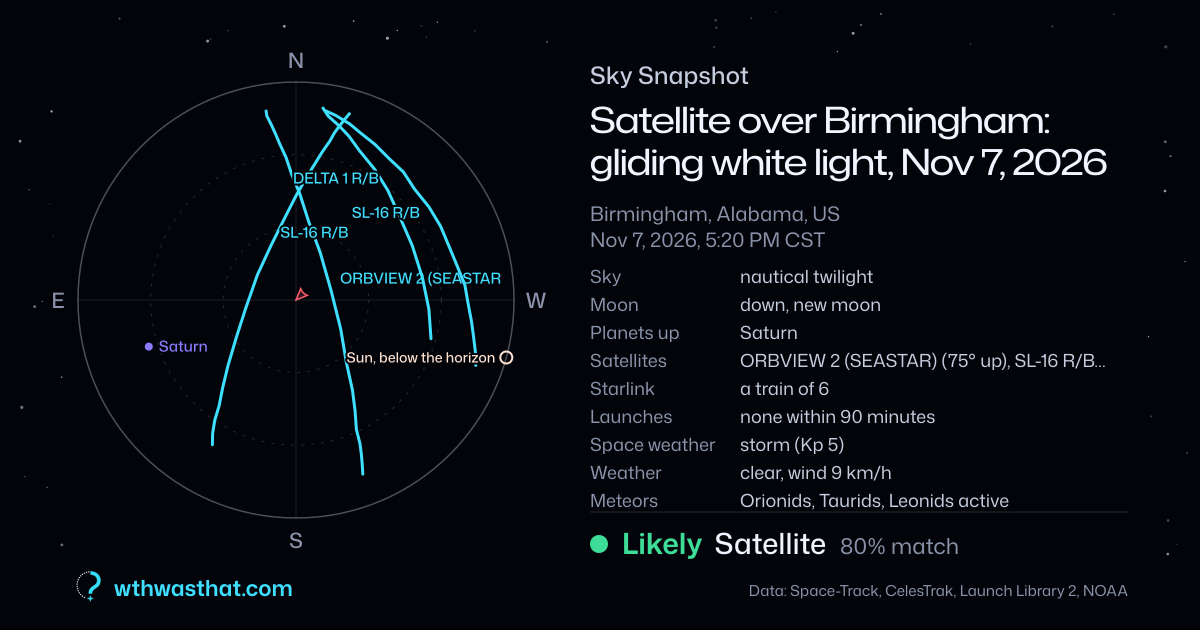
Sky Snapshot 5:20 PM, give or take 15 minutes

NSEWORBVIEW 2 (SEASTSL-16 R/BDELTA 1 R/BSL-16 R/BSaturn
5:20 PM
Sky
nautical twilight
Moon
new moon, below the horizon
Planets up
Saturn (26°)
Bright stars
Arcturus (west 5°), Vega (west 64°), Capella (northeast 2°), Altair (southwest 63°)
Weather
clear, wind 9 km/h
Space weather
storm (Kp 5)
Sunset
4:49 PM

Download the snapshot card to share it anywhere.

What the witness saw

When
Nov 7, 2026, 5:20 PM CST
Where
Birmingham, Alabama, US
Looking
northwest, straight overhead
Lasted
45 seconds
Looked like
one, white, point, steady
Sound
none

Bright light about as bright as a planet directly overhead moving north, getting dimmer as it moved. Obviously a satellite, looked like the ISS possibly

From above the area, the way they looked, and what was overhead

The map needs JavaScript. The checks below list everything it shows.

The circle is the area the report came from, rounded to about 10 km. We never show a witness's exact spot.

See it in 3D on the Sky Globe, at the moment it was seen

What it could be

  1. Satellite (ISS or another bright one) Likely80%
    • +22ORBVIEW 2 (SEASTAR), a satellite bright enough to see, was crossing your sky then, peaking 75° up.
    • +55 visible satellites were overhead in that window.
    • +15The direction you reported matches where it was.
    • -5The height in the sky doesn't quite match the pass.
    • +10A steady glide across the sky is how satellites move.
    • +8The duration fits a pass.
  2. Starlink train Doesn't fit40%
    • +45A train of 12 freshly launched Starlink satellites was passing over you then.
    • -10The direction doesn't match the train.
    • -20A single light isn't a train.
    • +10Steady, same-direction motion fits.
  3. Aircraft Doesn't fit35%
    • +10Steady straight-line travel.
    • +10The duration fits.
    • -10No blinking and no sound is unusual for an aircraft, unless it was far away.
    • +539 aircraft came within 40 km around that time (closest: N492TB, 1 km away at 5,300 ft).
    • -10None of them was in the part of the sky you described.
  4. Space debris re-entry Doesn't fit25%
    • +20Lasting tens of seconds to a few minutes fits a re-entry.
    • +10Slow, steady and horizontal.
    • +5Orange-white fragments fit.
    • -15Space-Track had nothing coming down near you around then.

Glad we could work it out. WTH Was That? is free for everyone; if it helped, a coffee helps cover the servers and sky data. ☕ Buy me a coffee

What we checked

  • Satellites: 5 visible passes: ORBVIEW 2 (SEASTAR), SL-16 R/B, DELTA 1 R/B
  • Starlink trains: train of 6
  • Launches: none within 90 minutes and 3,000 km
  • Reentries: nothing coming down nearby
  • Aircraft: 39 planes came within 40 km around then, the closest 1 km away (flight history)
  • Planets and Moon: Saturn, and the Moon was down
  • Space weather: storm (Kp 5)
  • Weather: clear, visibility 16.1 km
  • Meteor showers: Orionids, Taurids, Leonids
How we worked this out

We took a snapshot of the sky from 15 minutes before to 15 minutes after Nov 7, 2026, 11:20 PM UTC at 33.52, -86.77, and scored 20 possible explanations. Each one starts from how common it is, then gains or loses points for every detail the witness gave and every record we found. The points are listed next to each reason above. "Likely" means 80% or more and "Possible" means 50 to 79%. Anything lower doesn't fit, and if nothing reaches 50%, the case stays unexplained.

Sources: satellite orbits from Space-Track and CelesTrak, worked out with SGP4 (satellite.js); launch schedule from Launch Library 2; planetary Kp from NOAA SWPC; weather from NOAA NWS station KBHM; flight history from adsb.lol (ODbL); Sun, Moon and planet positions worked out on our server with astronomy-engine. Engine 0.7.0, snapshot v2, worked out Nov 13, 2026, 2:24 AM UTC.

Discussion 0 replies

Sky Investigator AI first look

Your best match is a satellite, and the timing fits. ORBVIEW 2 (SEASTAR) was crossing the sky then, peaking about 75 degrees up, and the direction you saw lines up with where it was. Several other satellites were overhead in that window too, so a steady point of light moving across the sky is what you'd expect. The height doesn't match the pass perfectly, which is why I'm not more certain. A Starlink train is less likely since trains show as a line of lights, not one point. An aircraft is less likely too, since planes usually blink and make some noise unless they're far away, and nearby flights were checked. Dimming as it moved is common for satellites as they pass out of sunlight.

• Did it fade gradually or disappear all at once?
• Which way did it appear to travel, from where to where?

This reply only uses the sky checks above, so it can't claim more than the data shows. Was it helpful?

Report