
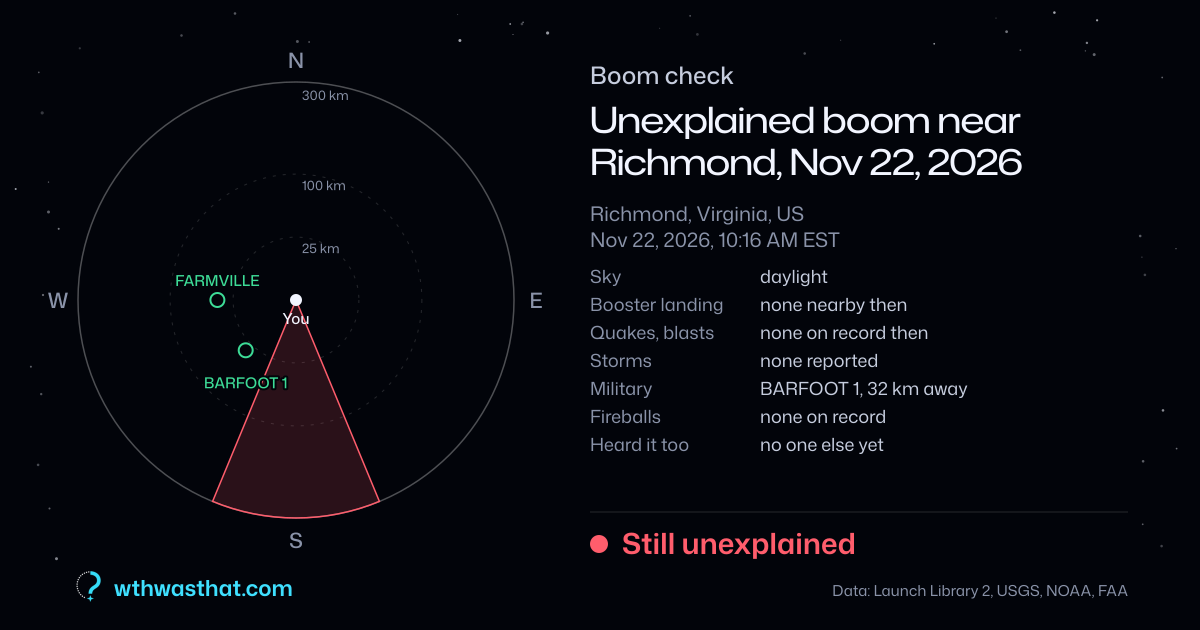
 Still unexplained: 9 checks, no match
Did you hear a boom?
Most booms have an everyday cause, and most leave a trace in public data. Tell us when and where you heard it, and we'll check launches and booster landings, the earthquake catalog, storms, military training areas, fireballs and our shows calendar for that minute.
What booms usually turn out to be
- A booster landing
- When a booster flies back to land at Cape Canaveral, Vandenberg or Starbase, its sonic boom (a sharp double thump) rattles windows 100 km away and more, about 8 to 12 minutes after liftoff.
- A small earthquake
- Shallow quakes, even small ones, are often heard as a boom or a rumble more than they are felt. The USGS lists them within minutes.
- A quarry or construction blast
- One sharp boom on a weekday in working hours. Some make the USGS catalog.
- Thunder
- It carries 15 to 25 km, so a storm you can't see can still be heard.
- Military training
- Fighter jets train at supersonic speed over the sea, and bombing and gunnery ranges can be heard a long way off.
- A fireball
- A meteor big enough to boom lights up the sky for a few seconds; the boom comes one to five minutes later.
- Fireworks
- A run of bangs at night, most of all on holidays and weekends.
- A transformer
- A flash (often blue or green) and a bang as the power flickers.
Booster landings coming up
- Cygnus CRS-2 NG-25 (Falcon 9): lifts off Nov 29, 2026, 10:50 AM EST; the booster comes back to LZ-40 about 8 minutes later, with a sonic boom.
- NROL-195 (Falcon 9): lifts off Nov 29, 2026, 4:00 PM PST; the booster comes back to LZ-4 about 8 minutes later, with a sonic boom.
Times are the launch site's. Launches slip, so check the launch page on the day.
The latest booms
Still unexplained: 9 checks, no match