
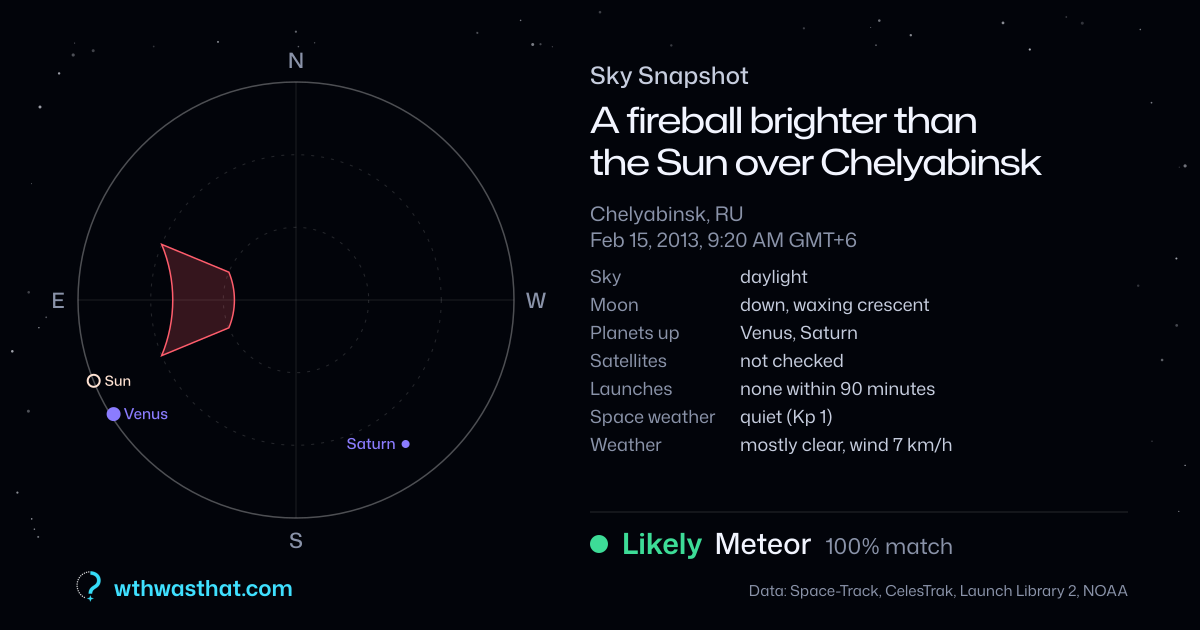
This is the Chelyabinsk fireball of February 15, 2013, a well-documented event. The top candidate is a meteor or fireball, scored 100%. It streaked fast across the sky for about five seconds, left a bright trail, and broke apart, which is typical of a large meteoroid. The boom that followed fits the shock wave from an airburst. Fireworks and re-entry debris scored lower, and each had reasons against it, such as the brief timing and the single trail. Because this write-up came from the site's team rather than a first-hand report, the details above are based on the archived record. The event broke many windows across the city, and the meteor's fragments were later recovered on the ground.
From the archive: the WTH team wrote this up from a real event that was widely reported at the time, to show how the checks work. The sources are at the end of the description.
From the archive / #2hn8djz2zts6
A fireball brighter than the Sun over Chelyabinsk
Space rock, burning upWant answers like this first in Google? Add WTH Was That? as a preferred source.
Sky Snapshot 9:20 AM, give or take 15 minutes
- Sky
- daylight
- Moon
- waxing crescent, below the horizon
- Planets up
- Venus (1°), Saturn (15°)
- Bright stars
- Arcturus (southwest 42°), Vega (southeast 68°), Capella (north 11°), Altair (southeast 34°)
- Weather
- mostly clear, wind 7 km/h
- Space weather
- quiet (Kp 1)
- Sunset
- 7:00 PM
Download the snapshot card to share it anywhere.
What people saw
- When
- Feb 15, 2013, 9:20 AM GMT+6
- Where
- Chelyabinsk, RU
- Looking
- east, mid in the sky
- Lasted
- 5 seconds
- Looked like
- one, white/orange, streak, fast, with a trail
- Sound
- boom
At 9:20 in the morning on February 15, 2013, a blinding fireball streaked across the sky over Chelyabinsk, Russia, leaving a thick smoke trail. For a moment it was brighter than the Sun. Minutes later the shock wave arrived, shattered windows in about 7,200 buildings and injured around 1,500 people, most of them cut by glass after going to their windows to look.
It was an asteroid about 20 meters across that came in from the direction of the Sun, which is why nobody saw it coming. It exploded about 30 km up, and fragments were later found on the ground, including a large one pulled from Lake Chebarkul.
Sources:
https://www.planetary.org/articles/what-was-the-chelyabinsk-meteor-event
https://en.wikipedia.org/wiki/Chelyabinsk_meteor
From above the area, the way they looked, and what was overhead
The map needs JavaScript. The checks below list everything it shows.
The circle is the area the report came from, rounded to about 10 km. We never show a witness's exact spot.
See it in 3D on the Sky Globe, at the moment it was seen
What it could be
-
Meteor or fireball Likely100%
- +35Over in seconds: that is a meteor.
- +20Very fast streaking motion fits.
- +15A streak or trail is the meteor signature.
- +15Breaking into pieces is classic fireball behavior.
- +5Green, blue or orange flashes come from the glowing metals in a meteoroid.
- +10A boom a minute or more later means a large fireball (and maybe meteorites on the ground).
- -5Daylight fireballs happen, but only the very bright ones show.
-
Fireworks Doesn't fit45%
- +15Brief bursts fit fireworks.
- +10Colored bursts fit.
- +15Bangs that arrive right after the flash fit fireworks.
-
Space debris re-entry Doesn't fit25%
- +20Multiple fragments traveling together is the re-entry look.
- +10Glowing trails behind each piece.
- +5Orange-white fragments fit.
- -15Too brief; a re-entry is slower than a meteor.
- ·Re-entry predictions (Space-Track TIP messages) are checked when available.
Glad we could work it out. WTH Was That? is free for everyone; if it helped, a coffee helps cover the servers and sky data. ☕ Buy me a coffee
What we checked
- Satellites: not checked (orbit data missing)
- Starlink trains: not checked
- Launches: none within 90 minutes and 3,000 km
- Aircraft: not checked (no flight history for this report)
- Planets and Moon: Venus, Saturn, and the Moon was down
- Space weather: quiet (Kp 1)
- Weather: mostly clear
- Meteor showers: none active
How we worked this out
We took a snapshot of the sky from 15 minutes before to 15 minutes after Feb 15, 2013, 3:20 AM UTC at 55.16, 61.40, and scored 21 possible explanations. Each one starts from how common it is, then gains or loses points for every detail the witness gave and every record we found. The points are listed next to each reason above. "Likely" means 80% or more and "Possible" means 50 to 79%. Anything lower doesn't fit, and if nothing reaches 50%, the case stays unexplained.
Sources: launch schedule from Launch Library 2; planetary Kp from GFZ Potsdam; weather from Open-Meteo; Sun, Moon and planet positions worked out on our server with astronomy-engine. Engine 0.4.0, snapshot v2, worked out Oct 29, 2026, 4:53 PM UTC.
Not available for this report: satellite passes.
Discussion 0 replies

Sky Investigator AI first look
This reply only uses the sky checks above, so it can't claim more than the data shows. Was it helpful?