Observers along the south coast of England and northern France saw a bright white and green streak cross the sky at 2:59 AM GMT on February 13, 2023. It lasted about five seconds, moved fast from the south at a low angle, made no sound, and broke into pieces. The data points strongly to a meteor or fireball, scored at 100. Fast streaking motion, a very short duration and a visible breakup all match that signature. Fireworks scored 45 and space debris re-entry scored 25, and both fit poorly, since re-entries are slower and fireworks rarely appear as a single silent streak at night. The sky was overcast and the aircraft check was unavailable, so visual confirmation was limited. Meteorites were later reported on the ground near Saint-Pierre-le-Viger, which supports the fireball explanation.
From the archive · #ggjtkwb6hfgq
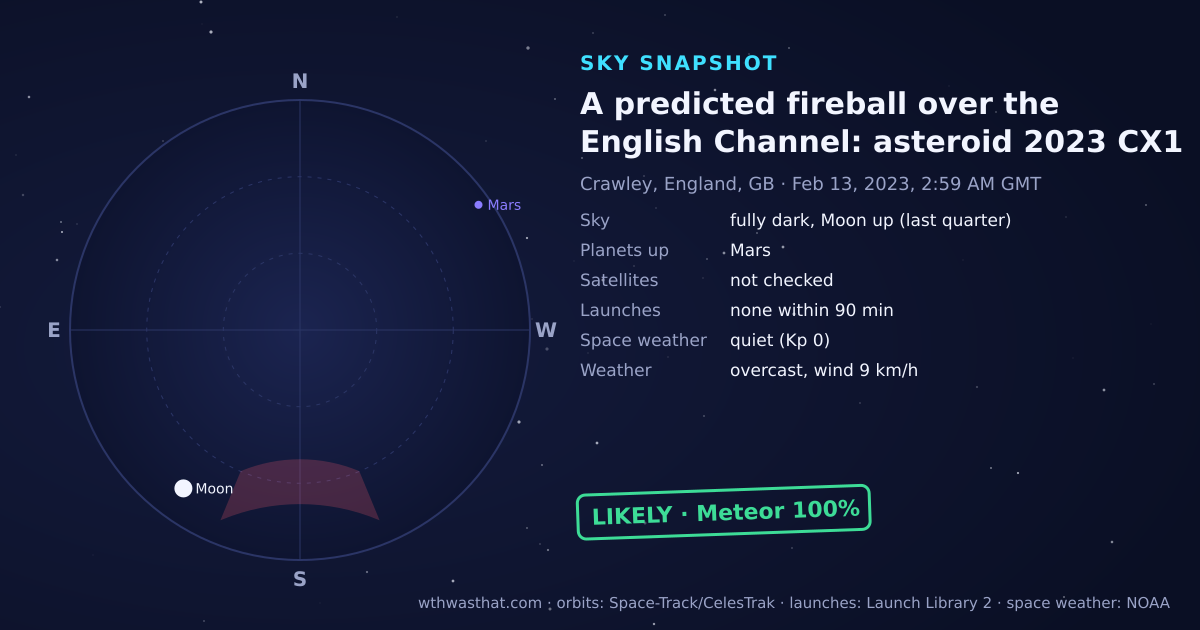
A predicted fireball over the English Channel: asteroid 2023 CX1
Space rock, burning upWant answers like this first in Google? Add WTH Was That? as a preferred source.
Sky Snapshot 2:59 AM, give or take 15 minutes
- Sky
- fully dark
- Moon
- last quarter, 13° up
- Planets up
- Mars (5°)
- Bright stars
- Arcturus (southeast 52°), Vega (northeast 28°), Capella (northwest 25°), Procyon (west 15°)
- Weather
- overcast, wind 9 km/h
- Space weather
- quiet (Kp 0)
- Sunset
- 5:13 PM
Download the snapshot card to share it anywhere.
What people saw
- When
- Feb 13, 2023, 2:59 AM GMT
- Where
- Crawley, England, GB
- Looking
- south, low in the sky
- Lasted
- 5 seconds
- Looked like
- one, white/green, streak, fast, with a trail
- Sound
- none
At 2:59 AM UK time on February 13, 2023, people along the south coast of England and across northern France saw a bright fireball flash over the English Channel and break apart. This one was unusual: astronomers had spotted the small asteroid, 2023 CX1, about seven hours earlier and predicted where and when it would hit.
It entered over the Normandy coast, broke up about 28 km above the ground, and meteorites were found in the following days near Saint-Pierre-le-Viger.
Sources:
https://en.wikipedia.org/wiki/2023_CX1
https://cneos.jpl.nasa.gov/news/news209.html
From above the area, the way they looked, and what was overhead
The map needs JavaScript. The checks below list everything it shows.
The circle is the area the report came from, rounded to about 10 km. We never show a witness's exact spot.
See it in 3D on the Sky Globe, at the moment it was seen
What it could be
-
Meteor or fireball Likely100%
- +35Over in seconds: that is a meteor.
- +20Very fast streaking motion fits.
- +15A streak or trail is the meteor signature.
- +15Breaking into pieces is classic fireball behavior.
- +5Green, blue or orange flashes come from the glowing metals in a meteoroid.
-
Fireworks Doesn't fit45%
- +5Night.
- +15Brief bursts fit fireworks.
- +10Colored bursts fit.
- +10Low in the sky.
-
Bird, bat or insect lit by a light Doesn't fit33%
- +30Fast, silent, erratic and brief at night is a bird or bat lit from below by streetlights.
-
Space debris re-entry Doesn't fit25%
- +20Multiple fragments traveling together is the re-entry look.
- +10Glowing trails behind each piece.
- +5Orange-white fragments fit.
- -15Too brief; a re-entry is slower than a meteor.
- ·Re-entry predictions (Space-Track TIP messages) are checked when available.
What we checked
- Satellites: not checked (orbit data missing)
- Starlink trains: not checked
- Launches: none within 90 minutes and 3,000 km
- Aircraft: not checked (no flight history feed yet)
- Planets and Moon: Mars, and the Moon was up
- Space weather: quiet (Kp 0)
- Weather: overcast
- Meteor showers: none active
How we worked this out
We took a snapshot of the sky from 15 minutes before to 15 minutes after Feb 13, 2023, 2:59 AM UTC at 50.82, -0.14, and scored 21 possible explanations. Each one starts from how common it is, then gains or loses points for every detail the witness gave and every record we found. The points are listed next to each reason above. "Likely" means 80% or more and "Possible" means 50 to 79%. Anything lower doesn't fit, and if nothing reaches 50%, the case stays unexplained.
Sources: launch schedule from Launch Library 2; planetary Kp from GFZ Potsdam; weather from Open-Meteo; Sun, Moon and planet positions worked out on our server with astronomy-engine. Engine 0.4.0, snapshot v2, worked out Oct 29, 2026, 4:53 PM UTC.
Not available for this report: satellite passes.
Discussion 0 replies

This reply only uses the sky checks above, so it can't claim more than the data shows. Was it helpful?